

Part V — The Future Creator
What actually matters when everyone has the same tools

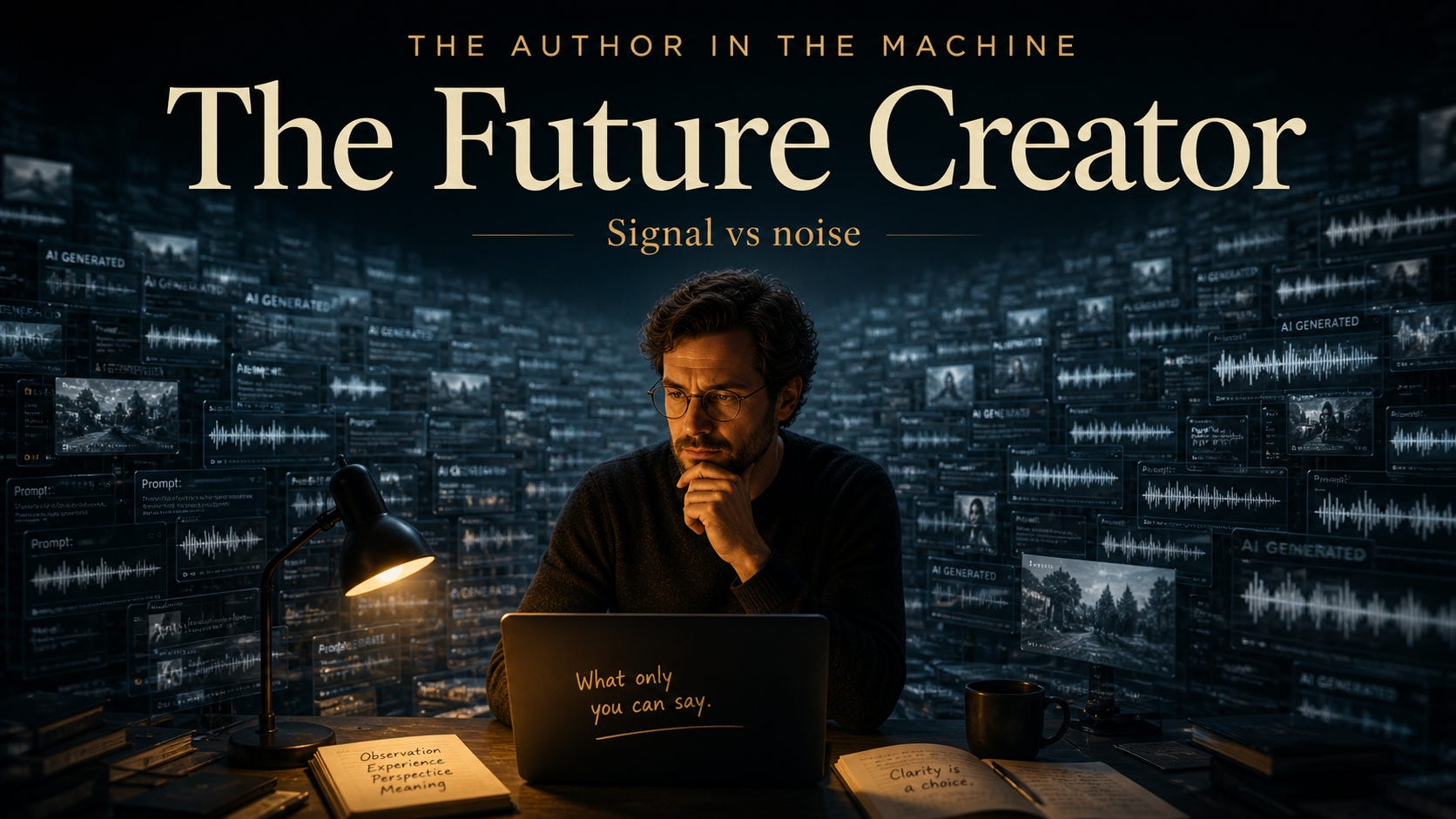
This essay is part of a series, The Author in the Machine — an exploration of authorship, technology, and the line between creative tools and creative replacement.
If you’re new here, start with the Prologue: The Machine Is Not the Musician.
Each installment builds on the last, examining AI-generated, AI-assisted, and AI-augmented work—and the question most people keep avoiding: who actually made the work?
Strip everything else away and you’re left with this:
The tools are no longer the advantage.
Everyone has them.
Or will.
The floor just dropped
For most of modern creative work, access was the barrier.
You needed:
equipment
studio time
technical knowledge
connections
That barrier is collapsing.
AI tools, digital platforms, and cheap production pipelines have lowered the cost of creating something to almost nothing.
That sounds like democratization.
And it is.
But it’s also saturation.
When everyone can create, creation stops being the differentiator
This is the part people don’t want to say out loud.
When the ability to produce becomes universal, it loses value as a signal.
Not because creation doesn’t matter.
Because it’s no longer rare.
What becomes rare is:
clarity
intent
restraint
point of view
Anyone can generate something.
Fewer people can make something worth keeping.
The explosion is already here
You don’t have to speculate about what’s coming.
Look around.
Endless AI-generated playlists
Content pipelines running 24/7
Most of it is functional.
Very little of it is memorable.
Because volume scales faster than meaning.
The signal problem
When everything looks finished, nothing stands out.
That’s the real consequence of automation.
Not that bad work gets made.
That indistinguishable work gets multiplied.
The audience doesn’t analyze why something feels empty.
They just move on.
Which means the burden shifts again.
Not to the tool. To the creator.
What actually separates people now
It’s not access. It’s not speed.
It’s not even technical execution anymore. It’s judgment.
The ability to decide:
what to make
what not to make
when something is finished
when something should be abandoned
That’s the work that doesn’t scale.
That’s the part that can’t be automated cleanly.
Taste becomes visible
For a long time, taste was hidden behind process.
You couldn’t always tell who had it and who didn’t because production limitations masked it.
Now those limitations are gone.
Which means taste is exposed.
Brutally.
If someone doesn’t have it, the tools won’t save them.
They’ll just produce more evidence of the absence.
Authenticity becomes a signal again
Not in the marketing sense.
In the structural sense.
People respond to work that feels:
intentional
specific
chosen
Even if they can’t articulate why.
That feeling doesn’t come from polish. It comes from authorship.
From decisions that could have gone another way—but didn’t.
The future isn’t human vs machine
That framing is lazy.
The real divide is:
creators who direct tools
creators who follow them
One group uses technology to extend their reach.
The other uses it to replace their responsibility.
Those paths do not lead to the same place.
The role doesn’t go away
The idea that AI eliminates the need for creators misunderstands what creators do.
They don’t just produce.
They decide.
They shape.
They reject.
They impose structure on possibility.
That role doesn’t disappear when tools improve.
It becomes more important.
The real skill going forward
Not prompt writing. Not tool mastery. Not output volume.
The real skill is:
Knowing what matters.
And acting accordingly.
What survives
When the noise increases, the signal doesn’t disappear.
It becomes harder to find.
And more valuable when it is.
Work that:
carries intent
reflects judgment
shows restraint
communicates something specific
That work doesn’t get replaced.
It gets separated.
Where this leaves the series
This wasn’t about defending or attacking AI.
It was about locating the line.
And now:
What actually matters when all of those exist at once.
The final question
The tools will keep evolving.
The output will keep increasing.
The line will keep getting harder to see.
None of that changes the question.
It only makes it more important.
When you encounter a piece of work—
music, writing, art, anything—
strip everything else away and ask:
Who actually made this?
Anyone Can “Write” a “Book” in a Day

Every few minutes now, somebody online is promising that with AI, you can write a book in a day. That line works because every word in it is doing dishonest labor.
Saved