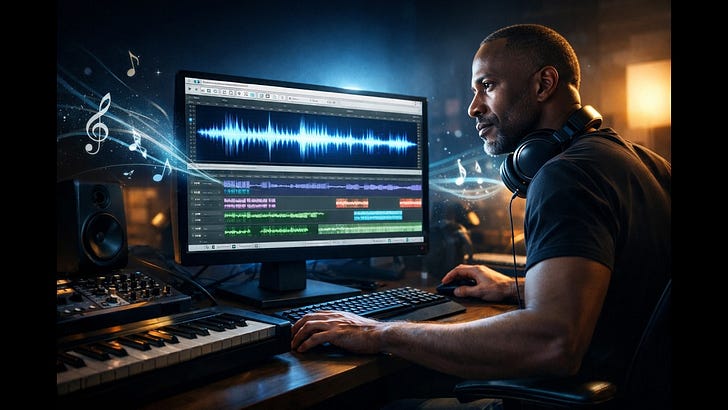
Part III — Augmented Creativity
When AI expands the artist instead of replacing them

This essay is part of an ongoing series, The Author in the Machine — an exploration of authorship, technology, and the line between creative tools and creative replacement.
If you’re new here, start with the Prologue: The Machine Is Not the Musician.
Each installment builds on the last, examining AI-generated, AI-assisted, and AI-augmented work—and the question most people keep avoiding: who actually made the work?
If Part I showed what happens when the machine takes over, and Part II showed what it looks like when the machine assists, this is where things get more interesting.
Because this is where the tool stops being passive.
And starts expanding what the creator can actually do.
This is not about efficiency
AI-assisted workflows make things faster.
AI-augmented workflows make things possible that weren’t before.
That’s the distinction.
This is not about shaving time off a process or generating variations on demand. It’s about extending reach—musically, visually, structurally—into areas that would otherwise require entirely different skill sets, resources, or time commitments.
The tool isn’t just helping you execute an idea.
It’s helping you explore ideas you wouldn’t have reached on your own.
The sketchpad becomes something else
At a basic level, creative work has always involved sketching.
You try something. You adjust it. You abandon it. You build on what survives.
AI turns that sketching process into something far more dynamic.
Instead of working through one idea at a time, you can branch.
You can test multiple directions at once:
alternate arrangements
different tonal palettes
variations in rhythm or phrasing
entirely different stylistic interpretations
Not to replace the original idea.
To pressure-test it.
To see what holds up when it’s pushed.
You can now hear what used to stay in your head
For most creators, there’s always been a gap between imagination and execution.
You hear something internally that you can’t quite reproduce:
because you don’t play that instrument
because the production would take too long
because the technical barrier is too high
AI starts closing that gap.
It allows you to:
mock up ideas outside your core skill set
experiment with textures you wouldn’t normally access
explore arrangements before committing real time and resources
That doesn’t eliminate skill.
It changes how skill is applied.
This is where serious creators will live
The people who actually make things aren’t looking for shortcuts.
They’re looking for leverage.
AI-augmented workflows provide that.
Not by replacing decision-making, but by increasing the number of meaningful decisions you can make in a given window of time.
You’re not just choosing between ideas.
You’re generating better ones to choose from.
The danger is subtle
This is also where things can quietly go off the rails.
Because when the tool becomes powerful enough to expand your options, it can also start to influence your direction.
Not overtly.
Gradually.
You begin to:
follow the most interesting output rather than your original intent
adapt your ideas to what the system produces well
drift toward patterns the model favors
That’s not collaboration.
That’s gravity.
And if you’re not paying attention, you stop steering.
Augmentation is not surrender
The difference comes down to one thing:
Who is setting the direction?
If the creator is using AI to explore, test, and expand ideas, the work remains authored.
If the creator is following the tool wherever it leads, authorship starts to blur.
Because now the system is influencing not just execution—but intention.
That’s a different role entirely.
New combinations, not replacements
One of the more interesting outcomes of AI-augmented workflows is the way they enable combinations that weren’t practical before.
A musician can:
explore orchestral textures without hiring an orchestra
test genre blends without rebuilding an entire production pipeline
iterate on sound design without deep specialization in synthesis
A writer can:
rapidly explore structural variations
test tone shifts across a piece
refine arguments through multiple framings
These aren’t replacements for skill.
They’re extensions of it.
The work doesn’t get easier
This is the part people misunderstand.
The barrier to entry may drop.
The bar for quality does not.
If anything, it rises.
Because when more is possible, more is expected.
The creator now has access to:
more options
more directions
more ways to refine or ruin a piece
Which means the responsibility increases.
Not decreases.
Taste becomes the bottleneck
In a fully automated system, the bottleneck is the model.
In an augmented workflow, the bottleneck is the creator.
Specifically:
Taste.
The ability to recognize:
what fits
what doesn’t
what’s excessive
what’s missing
AI can expand your reach.
It cannot tell you where to stop.
This is where authorship is tested
Augmentation doesn’t eliminate authorship.
It exposes it.
Because when you have more tools, more options, and more possible directions, the question becomes unavoidable:
Why this version?
Why this structure?
Why this sound?
Those answers don’t come from the tool.
They come from the person using it.
Where this leads
The most effective use of AI in creative work won’t be fully automated.
It won’t even be purely assistive.
It will be augmented.
A workflow where:
ideas are expanded
options are multiplied
possibilities are explored
But decisions remain human.
Direction remains intentional.
And the final piece reflects not what the system could generate—
but what the creator chose to make.
Next
Next in this series:
Part IV — The Gray Zone
Where authorship starts to blur: collaboration, curation, and the uncomfortable middle ground between tool and creator.