

Part IV: The Gray Zone
Collaboration, Promptcraft, and Curated Creation F

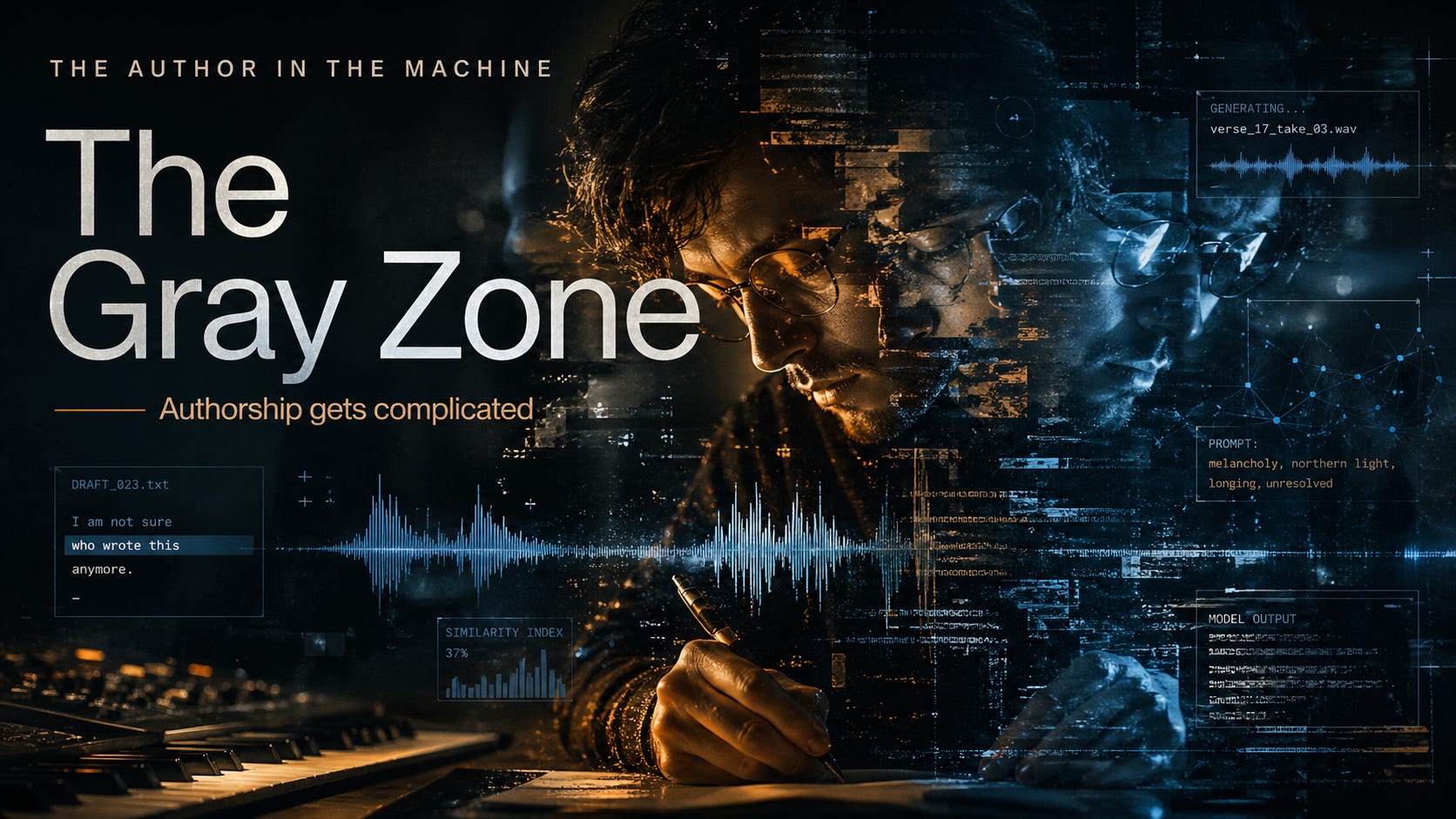
This essay is part of an ongoing series, The Author in the Machine — an exploration of authorship, technology, and the line between creative tools and creative replacement.
If you’re new here, start with the Prologue: The Machine Is Not the Musician.
Each installment builds on the last, examining AI-generated, AI-assisted, and AI-augmented work—and the question most people keep avoiding: who actually made the work?
Up to this point, the lines have been clean.
Part I: the machine generates everything.
Part II: the human uses the machine.
Part III: the machine expands the human.
Now the lines start to blur.
Because this is where authorship stops being obvious.
The problem isn’t the tool
The problem is attribution.
When you’re working with AI in a way that goes beyond assistance—beyond simple augmentation—you’re no longer just using a tool.
You’re interacting with a system that is actively shaping the output.
Not independently.
But not passively, either.
And that creates a problem that most people try to avoid:
Who deserves credit?
New categories nobody agrees on
The conversation keeps collapsing into “real” vs “fake” because the middle is harder to define.
But that middle is where most of the interesting work is happening.
Call it what it is:
AI-collaborative creation
The human and the system iterate together.
The creator sets direction, the system produces variations, and the process loops until something coherent emerges.
At what point does that stop being assistance and start being collaboration?
Prompt engineering as creative direction
A well-crafted prompt is not random input.
It encodes:
intent
constraints
tone
structure
In some workflows, the prompt is doing the same job a director or producer would do—guiding the outcome without physically executing it.
So the question becomes:
Is writing the prompt part of the creation?
Or is it just initiating it?
AI-curated work
In some cases, the creator doesn’t generate a single piece.
They generate dozens.
Hundreds.
Then select, refine, and assemble.
The output is not any one generation.
It’s the result of selection.
Which raises another uncomfortable point:
Is choosing the work the same as creating it?
Human editing as authorship
Editing has always been part of creation. But in AI workflows, editing becomes central. Not just polishing. Shaping. Rewriting. Rearranging. Removing. Reframing.
At what point does editing cross the line from refinement into authorship?
We’ve seen versions of this before
This isn’t entirely new.
We just haven’t had to confront it this directly.
A film director doesn’t operate the camera.
But we still say the film is theirs.
A music producer may not play every instrument.
But they shape the sound, the structure, the final result.
A DJ doesn’t compose the tracks they play.
But the selection, sequencing, and context can transform them into something else entirely.
In all of these cases, authorship isn’t tied to execution.
It’s tied to decision-making.
The difference is scale
What AI changes is not the concept.
It’s the scale.
A director works with a finite number of takes.
A producer works with a finite number of tracks.
A DJ selects from a finite catalog.
An AI system can generate effectively unlimited variations.
Which means:
more options
more decisions
more distance between input and output
That distance is where authorship starts to get harder to see.
Selection is not passive
There’s a tendency to treat selection as a lesser act.
As if choosing from outputs is somehow easier—or less meaningful—than creating them directly.
That’s not accurate.
Selection requires:
taste
judgment
restraint
clarity of intent
The more options you have, the harder those decisions become.
Anyone can generate options.
Not everyone can recognize which one matters.
But selection alone isn’t enough
Here’s where the line tightens again.
Selection is part of authorship. It is not all of it.
If the process is: Generate → pick one → publish
then the role of the human is minimal. Closer to filtering than creating.
But if the process is: Generate → evaluate → modify → combine → restructure → refine
then something else is happening. The human is not just selecting.
They are shaping.
The uncomfortable middle
This is where most people start reaching for simple answers.
Because the alternative is admitting that authorship isn’t always clean.
Sometimes it’s layered. Sometimes it’s distributed. Sometimes it’s difficult to assign cleanly at all. And that’s not a technical problem. It’s a conceptual one.
We’re used to thinking of creators as singular sources. One person. One work. One author.
AI workflows complicate that.
When does editing become authorship?
That’s the question this entire section collapses into.
Not:
“Did AI generate this?”
But:
“What did the human actually do?”
Did they direct the process?
Did they shape the outcome?
Did they make meaningful decisions?
Did they impose intent on the material?
If the answer is yes, authorship is present.
If the answer is no, it isn’t.
The presence of AI doesn’t answer that question.
The process does.
Why this matters
Because this is where trust starts to come into play.
Audiences don’t just respond to output.
They respond to perceived authorship.
Even if they don’t articulate it that way.
They want to know:
where the work came from
what was put into it
whether it reflects a point of view
If authorship becomes unclear, that signal weakens.
And when that signal weakens, everything starts to feel interchangeable.
Where this leads
The gray zone isn’t going away. If anything, it’s going to expand.
More tools. More hybrid workflows. More blurred lines between generation, assistance, augmentation, and collaboration.
Which means the burden shifts. Not to the technology. To the creator.
To be clear about:
what they did
how they did it
and what they’re claiming as their own
Because the more complex the process becomes, the more important that clarity is.
Next
Next in this series:
Part V — The Future Creator
What actually matters when everyone has access to the same tools—and why taste, judgment, and authorship become the real differentiators.
I think the confutation lays in the understanding of the lawsuit, this subject matter is about.
In that lawsuit the person tried claiming the AI as the author, which the courts said that the AI is a tool and therefor can't claim authorship or copyright.
Many people think (thanks to YouTubers like Top Music Attorney) that means anything produced by AI, the human can't claim authorship or have a copyrights. This is faults.
Authorship and copyright are a claim to ownership, which means AI can't claim ownership of the output, but the human that prompted the AI, regardless of how little or how much effort they put into the prompt, they have ownership of that output.
I understand you were talking more on the ethical/moral side of this topic. But I don't think it really matters to the majority of the consumers out there. Think about all the place of origin labels that are required for most products, that's been around for 4 decades now. They haven't changed consumers buying habits at all.
This is because people buy things based of 1st needs and wants, 2nd price, 3rd quality, 4th availability. Rather it was stamped out in a manufacturing plant or hand crafted doesn't matter. I think with AI it's no different.