

Empathy Is Not a Performance

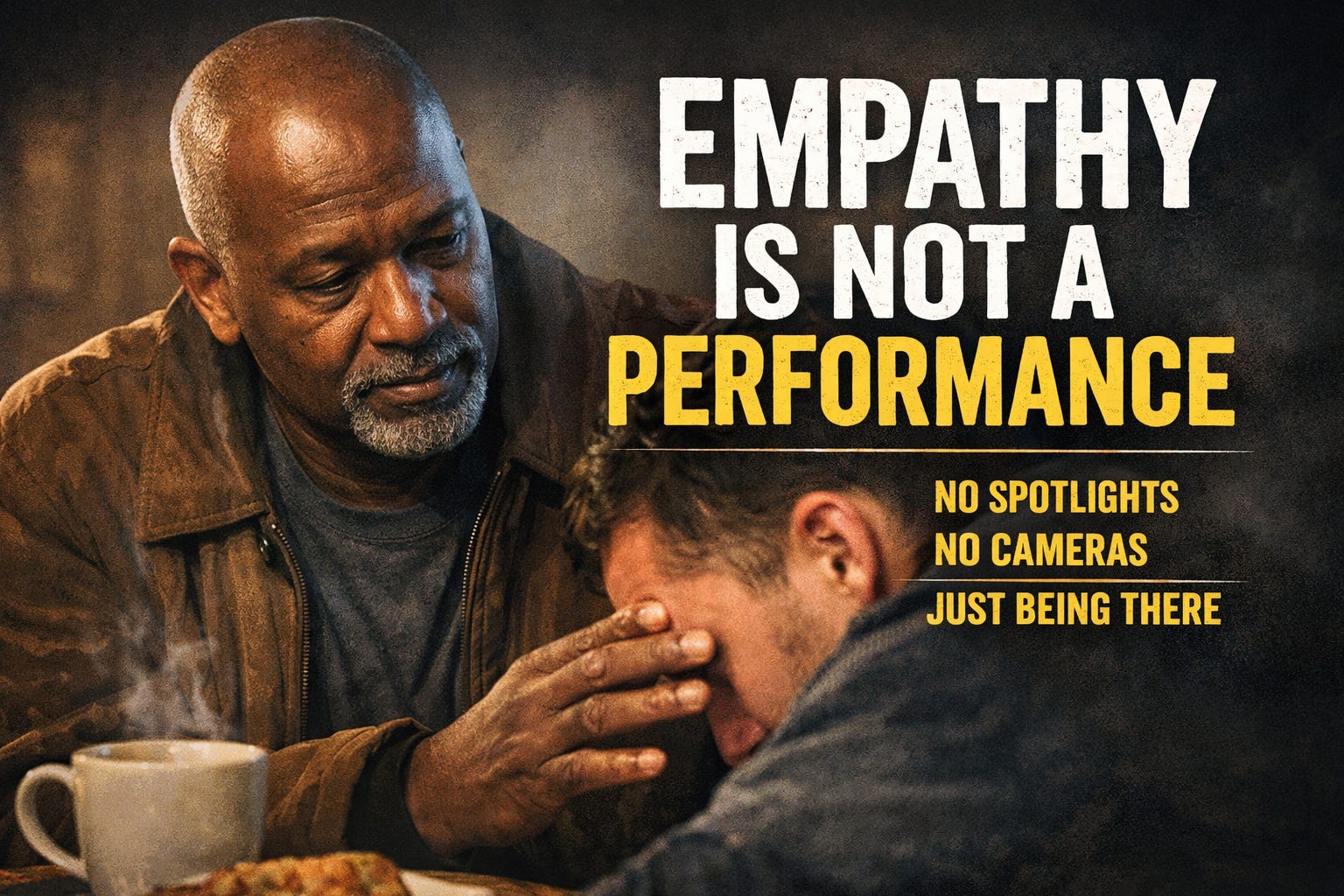
“Shawn, why don’t you go out and help people?”
“You should be on Facebook streaming the stuff you say at meetings. That’ll blow up for real.”
I hear this kind of talk mostly from people who call themselves believers. And every time I do, it confirms something ugly: modern “compassion culture” looks a lot like ancient Pharisee behavior with better lighting and a Wi-Fi connection.
There’s a passage in the Bible about not praying in public to be seen. The warning is simple: if attention is what you want, attention is what you’ll get—and nothing more. No spiritual credit. No moral bonus points. No invisible halo.
That principle doesn’t stop at prayer. It applies to anything sincere, non-commercial, and genuinely altruistic. If you need an audience to be compassionate, you’re not being compassionate. You’re auditioning.
What I Actually Do
I don’t run a nonprofit. I don’t have a “center.” I don’t brand my empathy. I don’t sell redemption with a logo on it.
I make myself available.
I sit with men who are dealing with the psychoemotional fallout of judicial misconduct—wrongful convictions, crooked prosecutions, institutional betrayal, years stolen by paperwork and indifference. I listen. I talk. Sometimes it’s over Japanese sweet potato lattes. Sometimes it’s pizza puffs. There’s no stage. No camera. No hashtag.
They don’t want public attention. Neither do I.
These men aren’t props. They’re not “content.” They’re not case studies for engagement metrics. They’re human beings trying to rebuild their nervous systems after being crushed by a system that pretends to be neutral and fair.
Empathy Isn’t a Business Model
Let’s be clear: I have no problem earning money. Work is work. Bills exist. But when I help people, it isn’t transactional. It isn’t outreach theater. It isn’t moral cosplay.
I don’t recruit. I don’t proselytize. I don’t “bring people into the fold.” I don’t show up to communities with pamphlets and prewritten hope speeches.
Real empathy doesn’t market itself.
It doesn’t require applause to function.
It doesn’t convert suffering into branding opportunities.
And it doesn’t confuse being seen with being useful.
Why Men Like Me Matter in These Spaces
I’m not coming at this from theory. I’ve been through things I wouldn’t wish on anyone—yes, even people I politically disagree with. I’ve survived systems that break people quietly, bureaucratically, and without apology.
That experience gives me credibility that no certification program can offer.
Men who’ve been wronged by institutions don’t want motivational slogans. They don’t want sanitized optimism. They don’t want to be lied to “with good intentions.” They want honesty, presence, and someone who understands what it feels like to be reduced to a case number.
Sometimes the most radical form of empathy is shutting up and staying put.
The Spotlight Is the Wrong Place for Sacred Work
Our culture has confused visibility with virtue.
If you’re not posting it, it didn’t happen.
If it’s not recorded, it doesn’t count.
If there’s no audience, it must not matter.
That’s nonsense.
Some of the most important human work happens in quiet rooms, parked cars, late-night phone calls, and coffee shops where nobody is trying to build a following. That’s where dignity is rebuilt. That’s where trust forms. That’s where men learn how to breathe again without pretending they’re fine.
“Do what is right without the spotlight.”
That isn’t modesty. It’s discipline.
It’s choosing substance over spectacle.
It’s refusing to turn pain into performance art.
Empathy isn’t content.
It isn’t branding.
It isn’t activism theater.
It’s showing up when nobody is watching.
It’s being present without needing credit.
It’s serving without building a shrine to yourself.
If that doesn’t scale well on social media, good. It was never meant to.
Some things are supposed to stay human.
Everyone’s kind when the camera’s rolling. Virtue signaling is a vice. Excellent piece!